
Talk. Draft. Iterate. Building Heinlein.
Some people obsess over cars. Some, games. Me? I obsess over word processors.
When you’ve spent as much time as I have inside one, you learn to be discerning. Word is fine to start, but try getting a novel ready for publication and you’re in for a world of hurt.
I loved Q10, a small, distraction-free writing program with daily word goals and typewriter sounds. And yes, the sounds were essential. I could open it and let the world fall away. If I reached the ding of my thousand-word goal, I considered it a win.
When it fell out of maintenance, I went looking. Scrivener tempted me to organize instead of write. Ulysses had a subscription. FocusWriter gave me quiet, but I needed to rearrange scenes. Obsidian with Longform came close, until sync issues scrambled my manuscript. Reorganizing 87 pieces of Markdown is not fun, let me tell you.
AI added another window to the pile. I sometimes draft alongside ChatGPT, and shuffling text got old. Sometimes its help also sanded off the weird parts in the name of editorial clarity. My prose is weird and that’s what makes it pop; I don’t want to be another genre writer; I want to make art.
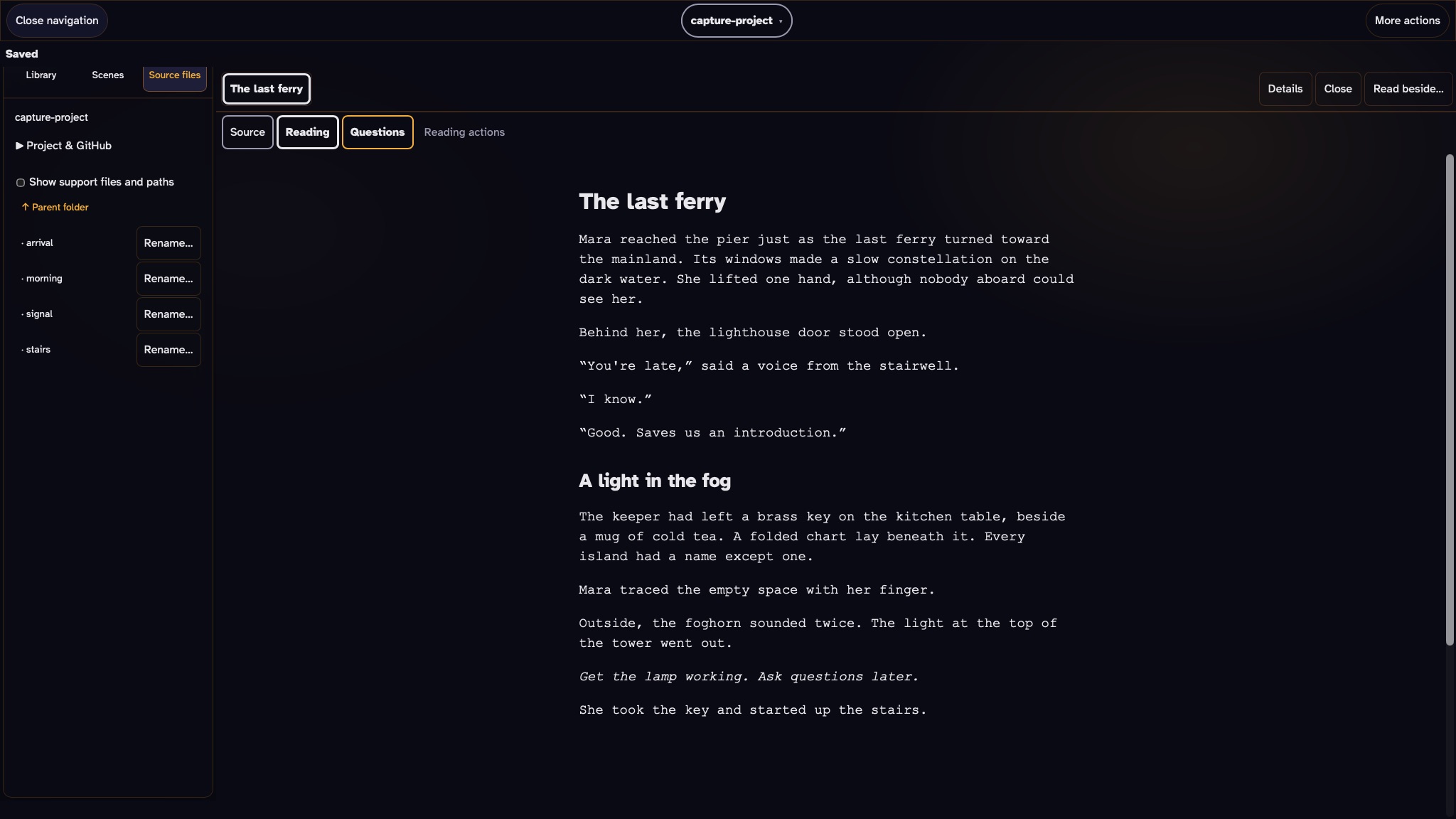
Eventually, I decided to tilt at windmills and give “surely, I can do better!” a go. I’m building Heinlein: a word processor for long manuscripts, bringing together movable scenes, AI editorial agents, and typewriter sounds. I want somewhere to write the book, examine what needs work, and approve revisions myself.
Naming it after Robert A. Heinlein gave me five rules to argue with.
Robert A. Heinlein’s five rules boil down to: write, finish, don’t rewrite unless an editor asks, put your work on the market, and keep it there until it sells. I still hear good advice in them. I also think they deserve another look in an era of AI and self-publishing.
Especially the one about rewriting.
You must write
Q10 understood that eventually you have to stop talking about the story you want to write and write the damn thing. I still need that. But writing doesn’t always begin with my hands on a keyboard. Sometimes it begins with me talking with someone.
I’ll talk through a character or scene with my wife, chase an answer, realize I’ve asked the wrong question, and head somewhere else. AI has turbocharged this important step: it’s like having a professional writer’s room whenever I need one. Sometimes the conversation helps me discover what I didn’t know I wanted to write.
I still tell the stories to my wife, sure. But nowadays I am an AI-voice-first writer.
Then I put it on the page. I’m building Heinlein around a manuscript as a collection of scenes: write them, move them, see how they fit. I want Q10’s space to concentrate alongside room to work on the shape of a book.
Of course, word goals and typewriter sounds are non-negotiable for my MVP, practicality be damned.
You must finish what you write
My first drafts used to be relatively clean because I solved problems as I went. If I couldn’t connect two moments, I might wrestle with the transition before writing anything else.
Now I’m more likely to leave a note: “get there.”
I learned that trick from another author, whose name I wish I remembered. It's a note to my future self: this section slowed me down and it ultimately does not matter for the story. Get There. It lets me acknowledge a gap without stopping the draft. I can discover what happens next and return when I understand what the missing piece needs to do.
AI helps me work through some of those gaps, too. My low vision means there are visual details I can’t always ascertain myself. I can talk through possibilities and decide what belongs in the scene.
The first draft has to give me something to work with. Leaving a gap means I can keep going long enough to find out what the story needs.
You must not rewrite, except to editorial order
Okay. This is the one.
I understand the danger. You can polish the beginning forever and never reach the end. You can rewrite the life out of something because you’re afraid to let anyone see it.
But once I’ve finished, I want to revise. I’m building Heinlein’s editorial agents to examine a draft through different lenses: emotional punch, continuity, rhythm and flow.
The principle is simple: observations and suggestions, not silent changes to my work. I approve revisions, reject suggestions, or take an observation back into a scene and try something else entirely. Protecting the weird parts matters as much as finding the rough ones.
The newsletter
Get the build notes.
I write about building AI systems in public—what worked, what broke, and what I’d do differently.
My version of the third rule: don’t let rewriting stop you from finishing, but don’t be afraid to revise once you know what you’re trying to make.
Talk, draft, iterate.
You must put your work on the market
Writing a story and letting someone read it are two different things. There’s always another conversation to have, another suggestion to consider. Eventually, I have to decide the story is ready to leave my desk.
Self-publishing makes that decision particularly concrete: I’m responsible for deciding when the work is ready for readers.
I spend hours writing, talking through problems, rearranging scenes, and revising. I accept some suggestions and reject others. My responsibility includes catching what the AI gets wrong and recognizing when a cleaner sentence makes a worse story.
When I put work into the world, I take responsibility for the whole thing.
You must keep it on the market until it sells
For a self-publisher, persistence can mean keeping a book available and continuing to help readers find it. Publication gives the work a chance to build an audience over time.
I still hear Heinlein’s challenge: don’t give up on the work because reaching people takes persistence.
With Estelle’s Children, finishing the manuscript gets me to the next job: bringing it to readers and continuing to help them find it.
That’s the part of Heinlein’s fifth rule I want to carry forward. A book needs a life beyond my desk.
After all the talking, drafting, accepting, and rejecting, I don’t always remember where each word began. I do know that I’ve chosen what stays. I care whether the story holds together, whether the characters feel true, and whether the finished work says what I need it to say.
What surprises me most is how much braver this process has made me. I’ll follow a character somewhere unexpected or write myself into a corner because I have ways to work through the problem when I’m ready to revise.
Talk. Draft. Iterate.
Writers have worked through versions of that loop for a very long time. Now we can bring AI into it, and I think we’re only beginning to understand what that makes possible.
Heinlein is on GitHub. Come see what I’m building.