
The Work Didn’t Disappear

I spent somewhere between five and twelve hours building a tabletop campaign that may never get played.
I used AI to help make it. That may be enough for some of the people I hoped to play with to opt out.
They get to make that choice. A game is an invitation, and an invitation has to leave room for no. I can be disappointed without turning somebody else’s boundary into a character flaw.
But I keep thinking about those hours. I was there for them. I know what I was doing.
Eight gatherings. One very strange Chicago.
The campaign is Savage Worlds: Message in a Bottle. Old heroes come back together after ten quiet years. They build a portal to bring a friend home. Chicago seems safe. Then the continuity errors start, cartoons become real, and familiar civic architecture stops behaving like a building.
The Thompson Center becomes a maze. An accelerator becomes a job that needs the whole party. Eventually, the story opens out into floating worlds above a primordial sea, borrowing imagery from my own fiction. The planned arc runs through eight gatherings, including the opening tutorial.
That’s a lot of machinery to put behind an evening with friends.
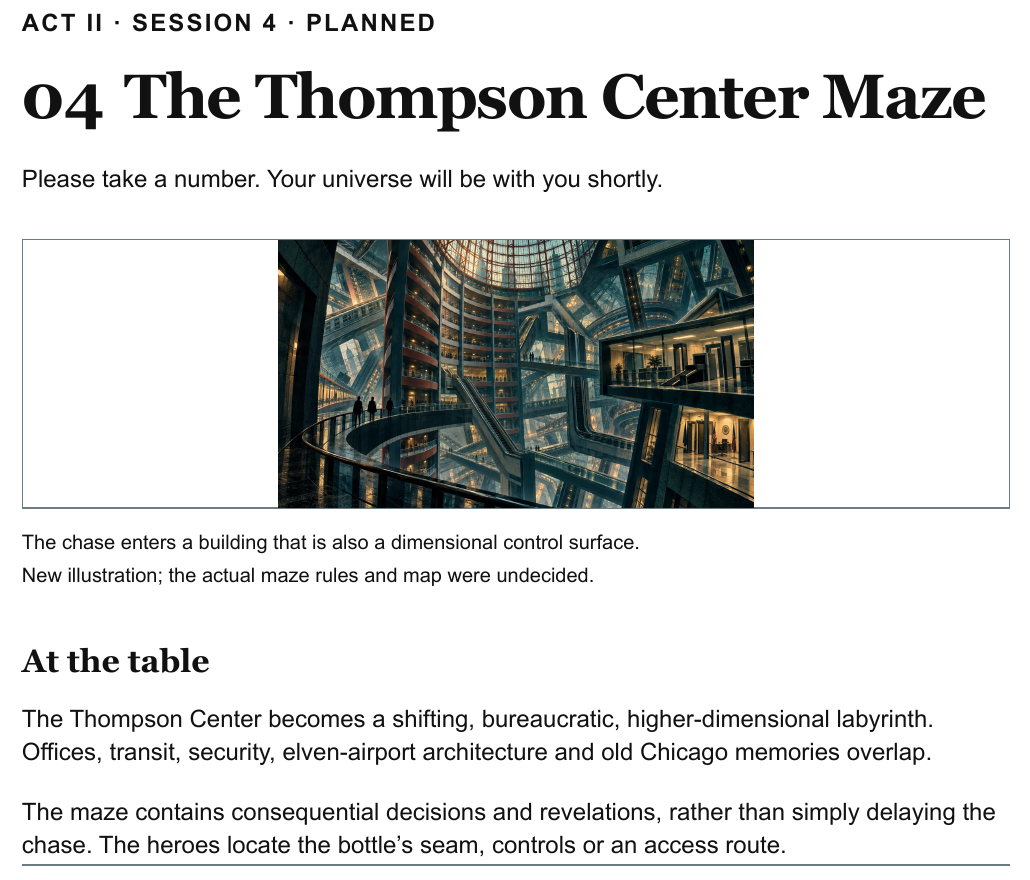
From the campaign PDF: the maze should give the players decisions and revelations, rather than simply delay the chase. Its illustration interprets the plan; the actual map and maze rules were still open. Select the screenshot to open it at full size.
The part I care about is how that machinery feels from the other side of the table. The opening portal teaches the rules through a shared problem. The friend comes home even if the party does badly; failure changes the cost. The first cartoon is funny until the implications stop being funny. The displaced cartoon people need help. Treating them as disposable monsters would miss the point.
Those are design decisions. They say what sort of game I want to run.
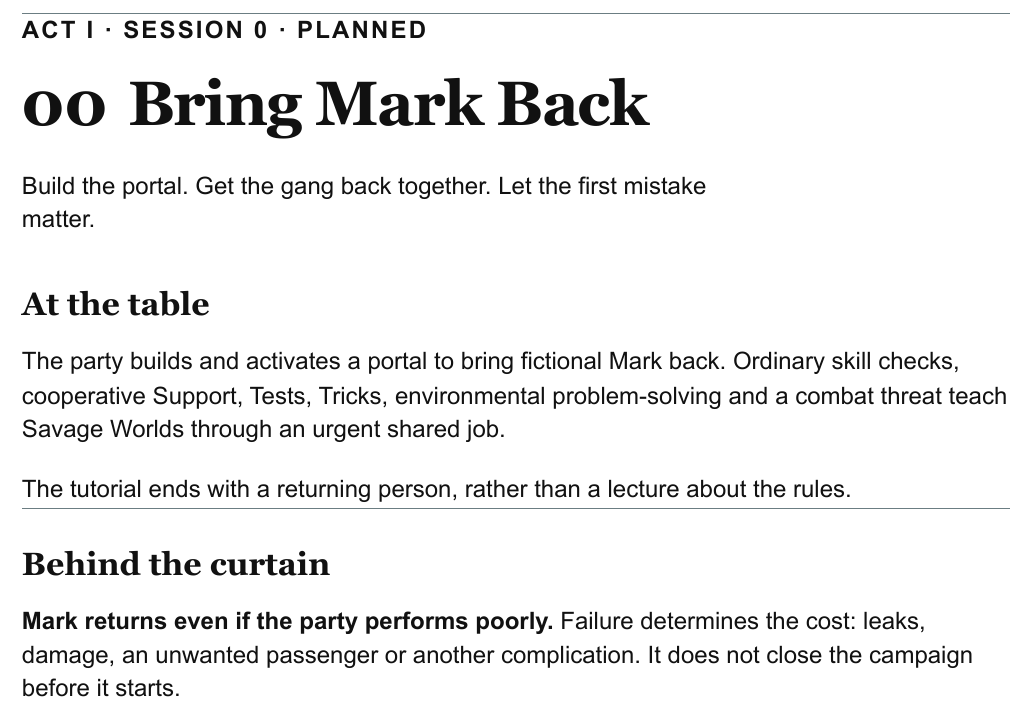
The opening teaches the rules through an urgent shared job. The friend returns even after poor rolls; leaks, damage, or another complication can become the cost. A failed roll shouldn’t close the campaign before it starts. Select the screenshot to open it at full size.
I also left things open. Specific stat blocks, some encounter mechanics, and detailed alternate finales weren’t settled. Later preparation was supposed to respond to what the players did earlier. A campaign outline is a promise to keep making something together, not a screenplay everybody else has to obey.
You can inspect the original preparation: read the illustrated campaign walkthrough in HTML or download the campaign walkthrough PDF. Both contain full GM spoilers, including the central reveal and intended ending. They distinguish decided plans, working options, plausible extrapolations, and gaps. This is the design as prepared, not a record of sessions played or a finished rules supplement.
Take it to your own table
I’m also offering Message in a Bottle as a free eight-gathering fan campaign for Savage Worlds Adventure Edition. Turning the outline into something another GM could run meant doing another round of work: scene procedures, NPC profiles, clues with backup routes, a maze map, handouts, and alternate outcomes. Those are additions for this edition, not things I’m pretending were all settled in the original five to twelve hours.
Open the GM guide and campaign runner, download the full GM module PDF, or get the offline package. There’s also a separate handout pack; give players the later sheets only when their scenes arrive. These resources contain full GM spoilers.
The guide borrows the useful shape of my Dread at the Wooden Shoe GM guide: read ahead without advancing the run, keep scene marks and notes, and put the clock and sound controls within reach. The procedures and campaign content here are for Savage Worlds. You’ll need the SWADE core rules. This is an unofficial, unplaytested fan edition, freely available without payment or a signup.
Use it, change it, and let your players make it stranger. The ending I prepared is a destination; what happens at your table belongs to the people there.
The illustration above comes from that walkthrough. Human-directed AI tools helped produce its writing, assembly, and illustrations, as well as develop the campaign. It depicts the plan; it isn’t an artifact recovered from a played session.
What happened in those hours
“AI-assisted” tells you that a tool was involved. It tells you very little about the work.
In this case, the work was designing, directing, revising, and preparing an experience. Deciding what belonged together. Deciding which jokes could carry real stakes. Making room for the players to surprise me. Looking at material and asking whether I actually wanted to put it in front of people I know.
A model can offer an encounter. I still have to decide whether it belongs in this campaign. A dramatic paragraph can sound terrific and make a lousy thing to run at the table. An explanation can tie every loose end into a bow and leave the players with nothing interesting to do.
Getting more material quickly makes those questions more available. It also makes them more necessary.
I don’t want to measure authorship by how many keystrokes I personally supplied. I want to look at what I meant to make, the choices I made along the way, and what survived revision. I’m responsible for the experience I’m offering. “The model suggested it” is no help if the evening is dull.
The newsletter
Get the build notes.
I write about building AI systems in public—what worked, what broke, and what I’d do differently.
AI didn’t make my hours disappear. It let me put more design into them.
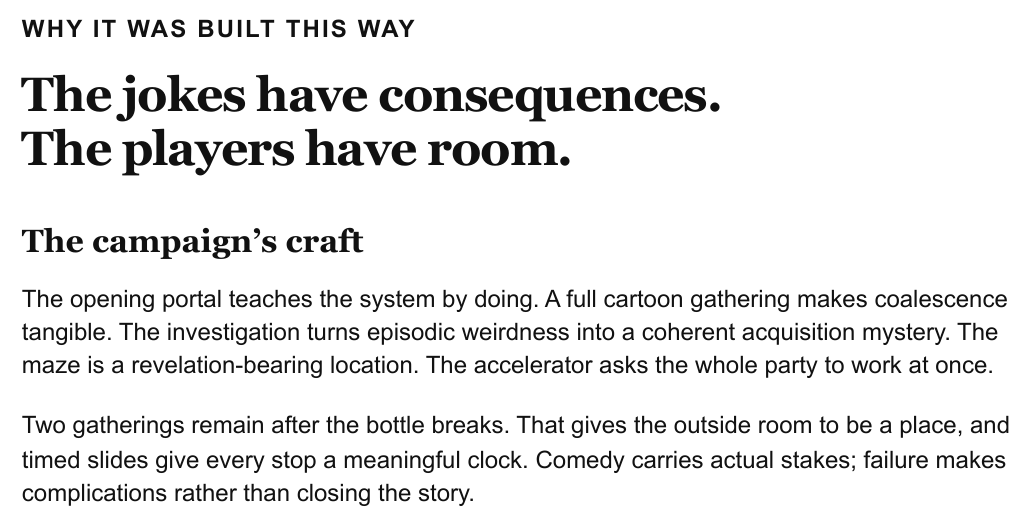
The design rationale ties the encounters together: teach through play, make the strange physics tangible, give the whole party a job, and leave two gatherings to explore the outside. Comedy carries stakes; failure creates complications. Select the screenshot to open it at full size.
I’ve seen the distance shrink before
I’ve spent twenty years in software engineering, watching the distance between an idea and a working prototype get shorter.
Higher levels of abstraction let us work with bigger pieces. Libraries give us behavior we used to have to assemble ourselves. Frameworks carry recurring decisions. Better tools let us try an idea while we still remember why it interested us.
The judgment moves. Once I can get a prototype running sooner, I can ask sooner whether anybody can use it, whether the interaction makes sense, and whether I’ve built the right thing at all.
That loop is the part I recognize in creative work now. An idea becomes something I can look at. Looking at it changes the idea. I revise, and the next version gives me another thing to react to.
There’s a difference between wanting a maze and deciding how a maze should work for this group, at this point in the story. Having something concrete to examine helps me get from one to the other. It gives my judgment somewhere to land.
I wrote about a related change in Why I Built Heinlein: making editions of a book while it’s still taking shape lets me inspect the production work while I can still act on what I find. The tool helps me carry out and test decisions I care about.
None of that means every abstraction is good, or every generated suggestion is useful. A faster loop can carry a bad idea a long way. I still have to recognize the bad idea and stop.
The invitation still matters
This campaign hasn’t had the test that matters most: people playing it.
I can show the structure and explain the choices. I can’t tell you the jokes landed, the pacing held, or a player did something wonderful that forced me to throw away my notes. Those things happen at a table. They may still happen. They may not.
And the people at that table have their own agency. My satisfaction with how I made something doesn’t settle whether they want to participate in it. I can be open about the tools and let them decide.
What I can tell you is that I spent those hours imagining an experience for other people. AI gave me more room to work on that experience: more material to consider, more chances to revise, more of the design made visible while I could still change it.
I didn’t spend less time caring about the campaign because I used AI.
I got to do more with the time I spent caring.