The villain. The trick. The intended ending. All of it is on the table.
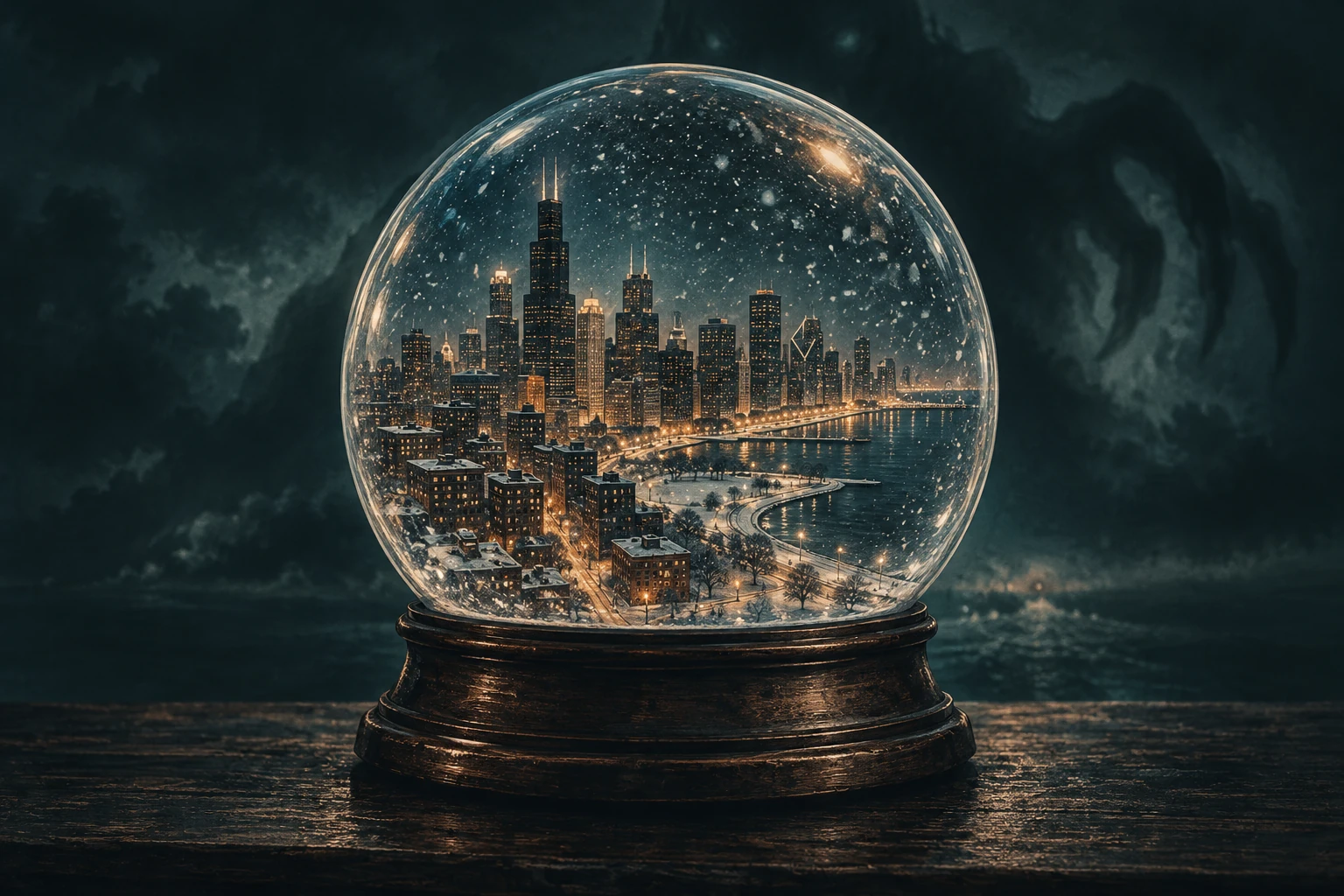
Chicago is the snow globe. That is the reveal. New illustration of planned material; appearance is interpretive.
Chicago is safe. Until you learn who owns it.
Old heroes. Ten quiet years. A friend coming home by a route that was, in the campaign’s own words, “suuuuper fucky.” Then cartoons spill into the city, civic architecture becomes impossible, and a mayor turns out to have purchased a result that should never have been for sale.
This is an account of how the campaign was planned to unfold. The recovered session pages all say “Not played yet.” These are the intended revelations and the choices prepared around them, not a record of player decisions.
The notebook is open. The surprise has left the building.
Explicitly decided story beats or intended outcomes. A plan still leaves room for players.
Working design
A prepared option or current baseline, deliberately open to revision.
Plausible extrapolation
A possible consequence added here to explain a branch. It was not established campaign canon.
Unknown
A genuine missing detail. The website does not quietly fill it in.
Recovered history is labeled separately. Those old images are remembered; their chronology often is not.
Act I · Session 0 · Planned
00 Bring Mark Back
Build the portal. Get the gang back together. Let the first mistake matter.
At the table
The party builds and activates a portal to bring fictional Mark back. Ordinary skill checks, cooperative Support, Tests, Tricks, environmental problem-solving and a combat threat teach Savage Worlds through an urgent shared job.
The tutorial ends with a returning person, rather than a lecture about the rules.
Behind the curtain
Mark returns even if the party performs poorly. Failure determines the cost: leaks, damage, an unwanted passenger or another complication. It does not close the campaign before it starts.
He describes a route through contradictory places, unstable passages or the space between universes. Getting here was “suuuuper fucky.” That line foreshadows the last act.
The branch
Working design: a clean return versus a return with collateral trouble. Portal construction could become a Dramatic Task. The combat opponent, construction logic, task difficulty and precise consequences were still unknown.
Let the old victory feel real before the world starts misbehaving.
At the table
The heroes reacquaint themselves with Chicago after ten peaceful years. Mark recounts impossible fragments from his journey. Small continuity errors are funny first and frightening later.
The gathering closes when the first cartoon becomes undeniably real.
Behind the curtain
Cartoons were already real in another reality. The problem is separation: realities are coalescing. Whatever higher-dimensional mechanism kept them apart has gravity; its precise nature was not chosen.
The apparent safety is the opening half of a bookend. By the finale, safety will mean freedom from ownership.
The branch
Unknown: the first visible error, which cartoon appears, and how much Mark can explain. Plausible extrapolation: investigating the glitches immediately could change how quickly the party notices a pattern; dismissing them could defer that investigation. No specific delay penalty was written.
The cartoons are people. The physics are the emergency.
At the table
Toon-bodied people and cartoon physics erupt into ordinary Chicago. The main encounter is a rescue and containment problem. Incompatible rules create slapstick and genuine danger at the same time.
Evidence connects the disturbance with city work, weatherization equipment or the mayor’s people. By the end, somebody is visibly benefiting from the chaos.
Behind the curtain
This is the full Ink and Paint cameo, but no named cameo character was selected. The displaced cartoon people are not disposable monsters. Their presence demonstrates a common explanation for the campaign’s apparently unrelated nonsense.
The city is being shaken. Municipal cleanup is also a trail toward the beneficiary.
The branch
Planned principle: creative rescue and containment. Plausible extrapolation: helping displaced people could produce allies or witnesses; treating them as invaders could damage trust. Those consequences, individual NPCs and cartoon-physics rules were not finalized.
The disasters are manufactured. The repair invoices are somebody’s good news.
At the table
The party investigates repeated outbreaks of reality chaos. The mayor’s home-repair and weatherization business profits from the damage. Evidence establishes that an outside actor can deliberately shake Chicago for entertainment.
The mayor either flees or draws the heroes into the Thompson Center.
Behind the curtain
The human owner was an alderman who wanted to be mayor. Scavenged higher-dimensional technology and an eligible straw buyer let him participate in Up’s estate auction.
He bought the outcome. Higher-dimensional interference made him mayor. Repair money is useful corruption and a clue trail; it is not the necessary mechanism behind his political success.
The branch
Planned: a fleeing mayor or a deliberate lure into the maze. Independent clues are meant to carry the investigation. Unknown: the exact evidence, chase trigger, whether heroes remember another election outcome, and whether title records name the human or his intermediary.
Please take a number. Your universe will be with you shortly.
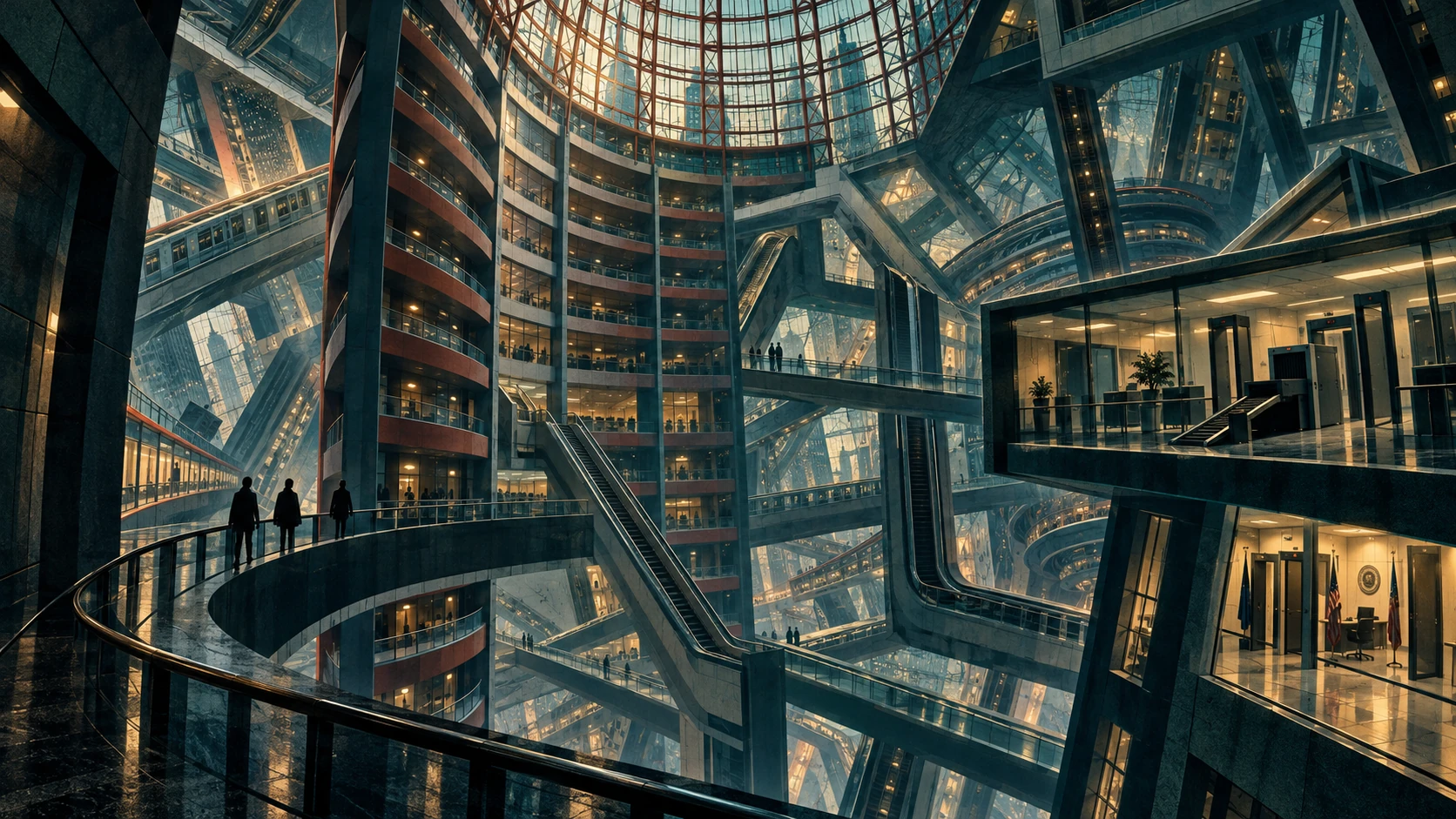
The chase enters a building that is also a dimensional control surface. New illustration; the actual maze rules and map were undecided.
At the table
The Thompson Center becomes a shifting, bureaucratic, higher-dimensional labyrinth. Offices, transit, security, elven-airport architecture and old Chicago memories overlap.
The maze contains consequential decisions and revelations, rather than simply delaying the chase. The heroes locate the bottle’s seam, controls or an access route.
Behind the curtain
Chicago is contained property. A human could not bid directly, so a higher-dimensional being bought on his behalf. Its compensation was Chicago as a living snow globe, with the right to shake it.
The accountant Up died accidentally; his collection went to auction. This is cosmic property administration with human-sized corruption.
The branch
Working design: the seam, control system and access route are alternative discoveries serving the same forward purpose. Unknown: navigation rules, the map, security encounters, and whether contractual cancellation alone could invalidate the sale. A legal shortcut was not established as a finished alternative solution.
A precise shot at the seam. An earthquake if precision fails.
At the table
The party reaches an accelerator installation and activates it as a Savage Worlds Dramatic Task under attack. Some heroes calibrate the beam; others maintain containment, supply power, fight attackers or evacuate people.
These problems happen concurrently. The earthquake is the failure clock, so the operation demands more than one person making the decisive roll.
Behind the curtain
Working fictional mechanism: the proposed geological anchor, the Sandwich Fault Zone in northern Illinois, becomes the physical shadow of a dimensional seam. Precision and resonance crack the ownership boundary. An overload transfers energy into the physical fault and makes the earthquake real.
The intended climax breaks Chicago’s container and throws the heroes into the primordial archipelago. Breaking the bottle is not the end of the campaign.
The branch
Working design: a correctly tuned shot versus an overload with earthquake consequences. The candidates were Argonne’s ATLAS, Fermilab, or a fictionalized Chicago Cyclotron installation. None was selected. These are fantastical campaign uses, not claims about real accelerator capabilities. The earthquake threshold, casualties and partial-success states remain unknown.
Important continuity boundary: the party definitely becomes adrift. Whether Chicago physically moves or stays safely in place was left open.
The islands drift. The sea bubbles. Your departure does not wait.
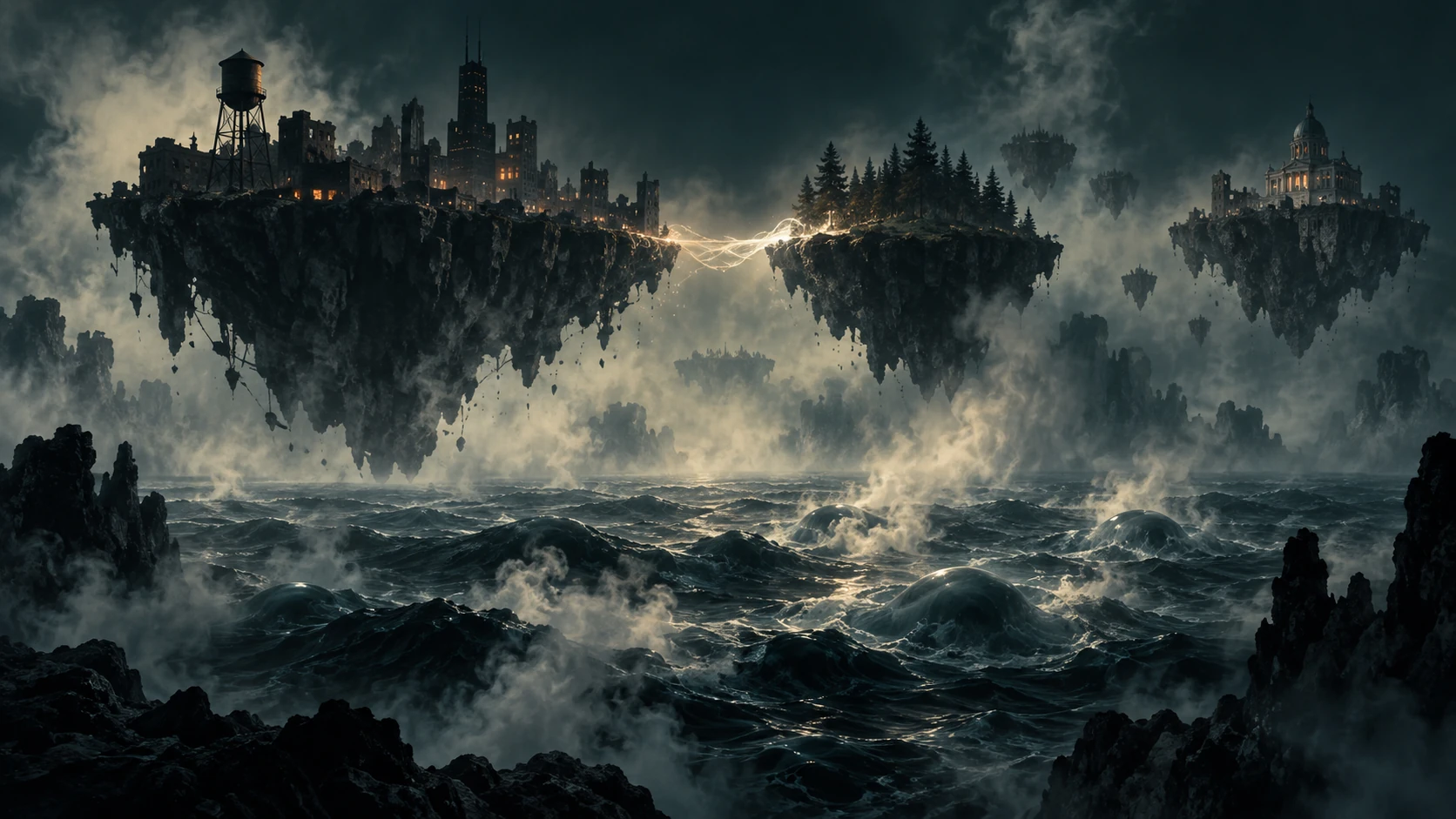
Outside the bottle: a primordial archipelago of drifting realities. New illustration. Specific islands and the travel vessel were not chosen.
At the table
The heroes learn how to sail among reality-islands over the foggy primordial medium. Unstable physics, story logic, Mark’s electricity or salvaged auction technology may make travel possible.
Every usable slide opens during a brief, predictable window. Helping, investigating and scavenging compete with the departure clock. One or two legacy images can return as islands or hazards without consuming full side quests.
Behind the curtain
Miss the window and the party may be stuck in that reality until another route appears. Lose contact with both sides while crossing and the heroes may be marooned between universes.
That distinction is deliberate. Failure changes the route and creates play. Mark’s difficult return warned them about it before they ever saw the sea.
The branch
Planned: catch a slide, miss one and seek another route, or risk between-space stranding. Unknown: the exact rescue procedure, vessel, island sequence and travel mechanics. The gathering ends with a route or message that can lead home; the form of that message is still open.
Bring the heroes home. Leave the ownership boundary broken.
At the table
The final voyage is a group problem: navigate the sea, preserve the route, hit the last slide window and resist the owner or straw buyer’s final attempt to stop the party.
Mark’s electrical powers pay off. They may energize a vessel, steer a passage, broadcast the message or reconnect realities. These are alternative uses, not four mandatory scenes.
Behind the curtain
The party sails back to reality without restoring Chicago’s old ownership boundary. The heroes are publicly hailed as heroes.
“Chicago is safe” returns with a changed meaning. The city is free because it belongs to its people, rather than merely looking peaceful inside someone else’s collection.
The branch
Planned destination: freedom and homecoming. Working design: the electrical solution and last opposition. Unknown: exact victory conditions, partial victory, a terminal failure ending and the final opponent’s form. No recorded play fixes which route the heroes would actually take.
Somebody bought Chicago. Somebody else gets to shake it.
Up dies a stupid death.
The higher-dimensional accountant who collected pocket realities dies accidentally: the fifth-dimensional analogue of being killed by mid-range cruise cocktail shrimp. There is no secret murder. The exact mechanics are inaccessible and deliberately irrelevant.
The collection becomes an estate sale.
The holding containing Chicago goes to auction. Whether the lot is Chicago, Earth, or a pocket reality containing both was never settled.
A human gets around the entry requirements.
Scavenged higher-dimensional technology lets a would-be mayor make contact. He uses an eligible straw buyer to bid indirectly. The technology’s origin and the finer points of legal title remain unknown.
The intermediary gets a living snow globe.
Chicago is its compensation. It can deliberately shake the city, causing overlaps, cartoon incursions, incompatible histories and manufactured disasters. It needs the population alive so it can keep enjoying the cruelty.
The human buys causality.
Higher-dimensional time manipulation makes the alderman mayor. Ballots, records, polling and public memory may rewrite themselves around the result. Whether the heroes remember another election remains an open clue decision.
The heroes break the property boundary.
The accelerator supplies the fictional precision needed to crack the bottle. Freedom costs the party its place in ordinary reality. The voyage home then becomes the final act.
What the players would learn first
Patterns in the disturbances. Municipal equipment near incidents. A mismatch between the apparent buyer and the beneficiary. Mark’s timed, unstable passages. These are independent evidence routes, rather than one conveniently omniscient speech.
What the GM would keep flexible
The straw buyer’s identity, profession, audience and philosophy. Reveal its appetite and contractual rights first. The same clues can support different prepared versions without requiring a retcon.
A returning player character with electrical powers. His portal arrival starts the campaign; his electricity helps make the voyage home possible. Origin, limits, costs and signature use of the powers were still unrecovered. This account uses the fictional character, without reproducing the real player’s biography.
The other old heroes
Unknown cast
The roster, character names, allies, enemies and last fictional statuses were not established in the available design. The site does not invent a party to make the story look finished.
Up
Recovered cosmology / planned estate-sale trigger
An accountant on a higher plane, worshipped by fuzzy creatures as their dimension’s keeper. He kept small universes like ant farms. His accidental death causes the auction. Investigating his death is intentionally an anti-mystery.
The human owner / mayor
Planned fictional antagonist
An ambitious alderman with a home-repair and weatherization business. The GM’s shorthand was “some Ricketts jagoff”; no finalized personal name was provided. This is a fictional local antagonist, not an allegation about an actual person. He buys cosmic leverage and lets disasters become business.
The Vivarium Keeper
Working design · current baseline
A collector of living habitats who calls a shake an “enrichment event.” Civilians are feeder stock; heroes are especially entertaining specimens. It might save them merely to endanger them again. Its care for the habitat is not care for its inhabitants.
The Cruel Naturalist / The Spectator
Prepared alternatives · not simultaneous canon
The Naturalist defends predation and suffering as healthy ecology, backed by professional status. The Spectator is a bored entertainment addict who rewards mayhem and follows favorite residents; an audience or wagering is only an option. The GM explicitly preserved either version, or a hybrid, as an audible at the table.
The setting is the mechanism
Chicago
The apparently safe city and actual living snow globe. Its politics, repairs and familiar buildings provide the trail into cosmic ownership.
The Thompson Center
A municipal labyrinth, bureaucracy and dimensional control surface. Elven-airport architecture can overlap its spaces.
The accelerator
A precise fictional resonance tool targeting the bottle’s seam. Installation undecided; earthquake danger is the working failure clock.
The primordial archipelago
Drifting reality-islands above a bubbling, foggy sea. Travel windows make compassion, investigation and departure compete.
The space between universes
A worse stranding than missing a slide inside a world. Its exact rescue rules and physical nature were not specified.
What survived from ten years ago
Recovered history: a Chicago water-tower battle with dragons and strange wasp creatures; an elevator into an airport-shaped elven realm with automatic-weapon security; and the fuzzy creatures beneath Up. Why the battle happened, who was allied with whom, and the order connecting the scenes remain unknown. They are possible echoes in the archipelago, not a forced itinerary.
The session spine fixes the intended revelations. Player choices were meant to alter routes, costs, allies and new canon. These are the branches actually supported by the notes, with an explicit limit on what is known.
The portal goes badly
Working design · Session 0
Mark still arrives. A leak, damage, an unwanted passenger or another complication carries failure forward. The particular complication was not selected.
The mayor runs—or lures them
Planned alternatives · Session 3
Both routes lead toward the Thompson Center, but change whether the heroes are pursuing a fugitive or walking into a chosen arena. No complete ambush encounter was written.
The beam overloads
Working design · Session 5
Mistuning couples the seam to the physical fault and turns the earthquake clock into an earthquake. The design does not define a casualty total or specify whether every failed activation still opens a passage.
The slide leaves without them
Planned consequence · Sessions 6–7
The party stays in that reality until another route appears. Losing both anchors during a crossing risks marooning them between universes. Neither is automatically a written terminal ending.
The bargain gets challenged
Unknown legal branch
Could cancelling shaking rights invalidate the sale? Does the straw buyer retain title? The bible asks these questions; it does not establish that negotiation or litigation can replace cracking the bottle.
Two plausible routes the notes leave room for
Plausible extrapolation: rescue work during the cartoon incursion could yield allies who help with evacuation later. Conversely, a party that chases the owner while neglecting civilians could return to a more complicated reception. Both follow the stated emphasis on meaningful choices and real consequences, but neither is a documented event or alternate finale.
The intended ending: the heroes sail home, the old ownership boundary stays broken, and the city hails them as heroes.
The first “Chicago is safe” is a comforting assumption. The final one is an earned political and cosmic fact within the fiction: the city is no longer someone else’s toy. Mark’s impossible arrival has become the first clue to the shared voyage that brings everyone back.
Freedom + homecoming
Planned ending
Break the bottle; navigate home; do not restore the old ownership; receive a public heroic welcome. This is the only fully stated final destination.
Freedom + delayed return
Plausible extrapolation
The city could be free while the heroes remain stranded after a missed slide. The travel rules permit the complication; the notes do not declare it a final ending.
Damaged victory or failure
Unknown finale states
The earthquake offers a possible cost; the owner’s last intervention offers resistance. Exact partial victories, sacrifices, terminal defeats and recovery routes were not chosen.
A failed roll is not evidence for a secret “bad ending.” There was no authored alternate-ending catalogue to reveal.
The jokes have consequences. The players have room.
The campaign’s craft
The opening portal teaches the system by doing. A full cartoon gathering makes coalescence tangible. The investigation turns episodic weirdness into a coherent acquisition mystery. The maze is a revelation-bearing location. The accelerator asks the whole party to work at once.
Two gatherings remain after the bottle breaks. That gives the outside room to be a place, and timed slides give every stop a meaningful clock. Comedy carries actual stakes; failure makes complications rather than closing the story.
The novel connection
The archipelago adapts imagery from the GM’s novel The Witch Who Sold the World: floating worlds above a liquid-nitrogen sea, higher-dimensional auction lots, and Claire perceiving and rewiring their connections.
The tabletop medium is a bubbling, foggy primordial sea. This is an intentional remix with Ink and Paint, not a canonical sequel to either book. No literal witch needs to have sold Chicago.
This account was assembled from the current campaign Pages and the original reconstruction work, reviewed October 8, 2026. Source names below link within this notebook. The private originals, player intake and correspondence are not bundled into the public-facing files.
Campaign bible
Current campaign history, cosmology, estate auction, human owner, straw buyer, reveal ladder, rules intent and open decisions. Primary authority for the spoiler explanation.
Session prep and notes + eight-gathering design discussion
Eight gatherings means Session 0 plus Sessions 1–7. The design discussion explicitly preserves the possibility that Chicago stays in place while the heroes become adrift.
All eight session Pages
Session 0 Bring Mark Back — portal tutorial and fail-forward return.
Session 1 Chicago Is Safe — continuity errors and first real cartoon.
Session 2 Ink and Paint — rescue, containment and municipal clues.
Session 3 Shake the Snow Globe — ownership investigation and mayor’s exit.
Session 4 The Thompson Center Maze — control surface and straw-buyer reveal.
Session 5 Crack the Bottle — Dramatic Task and earthquake clock.
Session 6 Adrift in the Universe — timed slides and stranding.
Session 7 Message in a Bottle — electrical payoff, freedom and heroic return.
Every page remains an unplayed plan with an unfinished prep checklist.
Campaign reconstruction log + earlier design chat
Recovered ten-year-old images; explicit GM decisions; superseded six- and seven-gathering scopes; the preserved antagonist audible; accelerator options; archipelago imagery; and the final eight-gathering spine. Later decisions take priority over earlier guesses.
The Witch Who Sold the World — Hazelton manuscript
Source imagery for floating worlds, the nitrogen sea, auction infrastructure and Claire’s rewiring. The campaign bible and reconstruction log document the adaptation and canon boundary.
Execution plan + Player interview sheet
Confirm the eight-gathering scope and the intention to let player memories inform the revival. Private answers are not reproduced. The local “New SW game” sources folder contained no synced files at review.
Compile Campaign Html Site
The prior conversation supplies the open-GM-notebook framing and intention to share the craft. It supplies no additional plot.
What never became finished canon
Edition and starting Rank; the returning roster; Mark’s power build; specific NPCs and stat blocks; encounter maps; maze rules; clue wording; the straw buyer’s final persona; ownership law; the technology’s origin; election memories; the accelerator location; the slide-catching vessel; island order; final opposition; and precise victory, partial-victory and failure mechanics.
These gaps were part of a flexible preparation strategy. Later gatherings were to become fully runnable after earlier player choices. A retrospective can reveal the design, but it cannot supply those unmade choices as facts.
Here is the game we could have played.
This adventure was conceived and directed by a human using AI-assisted tools. Human-directed AI tools assisted the campaign’s development and this website’s writing, assembly and new illustrations. The illustrations are interpretations of documented plans; they are not recovered session artifacts.
It was intended for a table. Here, the notebook is open: the jokes, the machinery, the secrets, and the ending.